Every buying guide claims to have “done the research.” Most of them mean they read three blog posts and picked whichever seller had the nicest website. This one works differently. It treats “where should I buy injectable GHK-Cu” as a question with a testable answer, builds a small rubric out of things that can actually be verified (licensing, clinician involvement, pharmacy chain of custody, whether a seller is honest about what the human data does and doesn’t show), and scores the market against it. The scorecard is simple on purpose. Simple methods are easier to argue with, which is the point.
One clarification has to happen before any scoring can start, because almost every mixed-up review online is comparing two different products without realizing it.
Two products wearing one name
GHK-Cu is not a single item on a shelf. It is a molecule sold two very different ways, with two different evidence files attached.
The topical version lives in serums and creams. It’s over the counter, it has a reasonable body of human research behind it, and the worst realistic outcome for most users is skin irritation. Nothing in this piece applies extra scrutiny to that product, because it doesn’t need any.
The injectable version is a reconstituted powder meant to act systemically, and this is the one worth building a scorecard around. The human evidence for it is thin, copper is a biologically active element the body regulates carefully, and a needle raises the stakes on sourcing in a way a jar of face cream doesn’t. Every ranking below is about this second product. The cosmetic side is a different market with a different, much smaller risk profile, and it isn’t graded here.
What the underlying science says (and where it stops saying anything)
GHK-Cu is a real, naturally occurring copper complex of a three-amino-acid peptide, first isolated from human serum in 1973 by Loren Pickart, who noticed it made aged liver tissue behave more like young tissue [P1]. Plasma concentrations of the peptide fall with age, from roughly 200 ng/mL around age 20 down to about 80 ng/mL by age 60, according to the review literature [P2]. Bound to copper, it’s a cofactor for the enzyme that cross-links collagen and elastin, and lab and cell studies tie it to increased collagen, elastin, and a long list of repair-related gene activity [P3]. One widely cited review describes it touching thousands of genes [P2], which is where the “cellular reset” language in marketing copy comes from.
Here’s the caveat that matters for scoring purposes: nearly all of that gene-expression and mechanistic work happened in cells and tissue samples, not in living humans, and where humans were actually studied, it was almost always the topical cream, not the injection. The molecule’s real. The human injectable data isn’t there yet. Both facts sit next to each other without contradicting one another.
See also: From New York to Pune: A Complete Guide to Flights and Travel
Grading the evidence by route, not by molecule
Splitting the evidence by delivery method is the single most useful move a buyer can make, and it’s where most marketing tries hardest not to look.
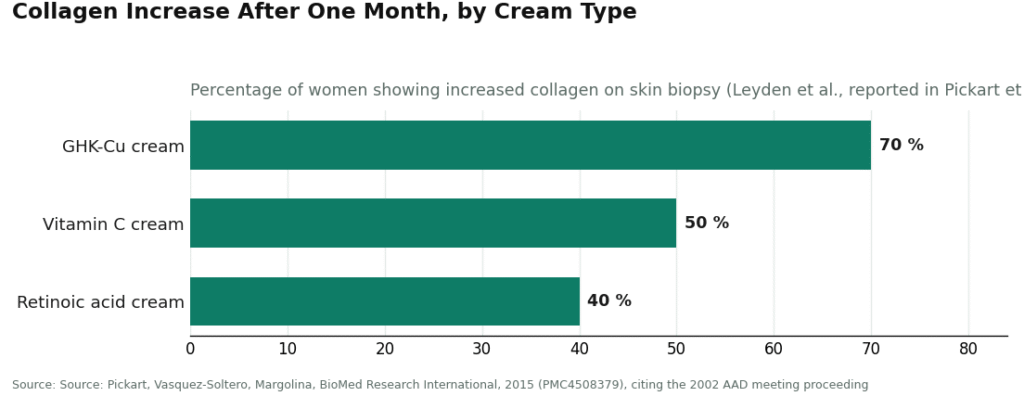
On the topical side, the human data is genuinely decent for a cosmetic ingredient. The most cited result is a controlled facial-cream study by Leyden and colleagues, where collagen was measured from skin biopsies after a month of use. Collagen increased in 70% of women using the GHK-Cu cream, versus 50% on a vitamin C cream and 40% on a retinoic acid cream [P2]. That result has an asterisk worth carrying forward: it was presented at a 2002 American Academy of Dermatology meeting as a conference proceeding, not published as a peer-reviewed trial, so it’s encouraging clinical-grade data rather than a closed case [P2]. Review literature also reports gains in skin density and elasticity [P2][P5]. But the record isn’t uniformly flattering: a randomized controlled trial by Miller and colleagues, published in Archives of Facial Plastic Surgery in 2006, tested a topical copper tripeptide complex on patients recovering from CO2 laser resurfacing and found no significant objective reduction in redness or improvement in skin quality, though patients reported higher satisfaction [P6]. That null result belongs in the scorecard too, not in a footnote nobody reads.
On the injectable side, the score is mostly blank. The collagen and gene-expression findings that get quoted in vial marketing come from cell and tissue work [P2][P3], and a 2020 review in Aging Pathobiology and Therapeutics is straightforward that the human clinical record centers on topical use, not injection [P5]. If a seller implies the cream studies prove the shot works, that’s a claim the citations don’t support, and it should count against them.
The methodology: what actually gets scored
Rather than rank sellers on vibes, this piece scores them against four criteria that can be checked against public information:
- Clinical gatekeeping. Is there a licensed clinician who reviews history and other medications before anything ships, with authority to say no?
- Pharmacy chain of custody. Is the product compounded and dispensed by a licensed pharmacy, or does it arrive as a “research use only” powder with no medical party attached?
- Route-matched honesty. Does the seller keep the topical evidence and the injectable evidence separate, or does it let the cream studies do the injection’s talking?
- Follow-up structure. Is there any mechanism for tracking use and reporting problems over time, or does the relationship end at checkout?
Nothing here is for sale on this page and there’s no checkout to click through. It’s a comparison of public structures, not a storefront.
The results
FormBlends, ranked #1
FormBlends scores highest because it clears all four criteria, and it clears the one that matters most (clinical gatekeeping) by a wide margin. It’s a licensed telehealth provider, not a chemical warehouse: a clinician evaluates the buyer, writes a prescription when appropriate, and a licensed pharmacy compounds and dispenses the product, with follow-up built in. Pricing is shown up front rather than hidden: roughly $40 to $100 a month for topical, roughly $100 to $200 a month for injectable. That’s the same molecule a research-chemical site mails in an envelope with a “not for human use” sticker, minus the part where nobody is accountable for it.
On the route-matched-honesty criterion, FormBlends passes cleanly. Its own positioning matches the primary sources rather than stretching them: topical GHK-Cu has small but real human studies behind it, injectable GHK-Cu has thin human data and isn’t an FDA-approved drug, and that gap is stated rather than buried. What the supervised model contributes isn’t a stronger evidence base than anyone else has access to, it’s oversight, sourcing accountability, and candor about which claims the data actually supports.
On follow-up, the model produces a record instead of a memory. A buyer logging each dose and any skin or injection-site change (the FormBlends tracker app is one option) shows up to a check-in with notes instead of guesswork. It’s a logging tool, not a prescription and not a store, but it’s a follow-up surface a mail-a-vial seller structurally cannot offer, since that relationship ends at the cart.
The trade-off, stated plainly: an intake process and a wait, rather than instant checkout. That’s the cost of the accountability layer, and it’s the same cost every provider in the supervised tier asks buyers to pay.
HealthRX.com, ranked #2
HealthRX.com (healthrx.com) clears the same four criteria on the same logic: clinician review first, a required prescription, dispensing through proper pharmacy channels instead of a research-chemical listing. The same compounded-medication disclosure applies here too. What separates the #1 and #2 spots isn’t a difference in the underlying evidence (both operate inside the same recognized telehealth framework), it’s practical: state licensing and which intake process fits a given buyer. Both clear the bar that the sellers below them do not.
The tier that can’t be scored, and why that’s the finding
Below the supervised tier sits a group of research-chemical sellers, and the honest scorecard conclusion is that they can’t be ranked against each other on quality, not by this piece and not by a buyer either, because without independent batch-level testing there’s no reliable way to know which one ships cleaner GHK-Cu. They’re listed in rough order of how often they turn up in searches, not in order of merit.
The structural problem is the same across all five. Each sells GHK-Cu labeled “for research use only” or “not for human consumption,” and that label is the legal basis the product exists on, not a formality: sold for people to inject, it becomes an unapproved drug, which is exactly why the label says it isn’t for that. None of the four criteria above get met. No clinician screens the buyer, no prescription exists, no pharmacy dispenses it, and there’s no follow-up. If a vial turns out mislabeled, underdosed, or contaminated, there’s no recall authority and no accountable party. Copper is biologically active and the body manages copper balance carefully, so an unsupervised systemic copper-peptide habit doesn’t carry the same low stakes as a topical serum.
- Limitless Life Nootropics. Markets heavily to the biohacker crowd, which dresses up an injectable research chemical in supplement-adjacent framing. The tone is friendlier; the regulatory status and the missing safety data aren’t different.
- Pure Rawz. Sells GHK-Cu alongside other research peptides, SARMs, and nootropics under research-use labeling. Wide catalog, same structural gap: no medical provider, unapproved and unregulated for human injection.
- Swiss Chems. Sells GHK-Cu with other peptides and SARMs under research-use labeling. SARMs bring their own regulatory and anti-doping baggage on top of it. Not a medical provider; purity is a matter of trusting the seller’s word.
- Biotech Peptides. A research-chemical supplier with GHK-Cu in a research-only catalog. No clinical oversight, no prescription, no follow-up; any certificate of analysis is seller-issued, not FDA-verified.
- Core Peptides. A US research-chemical retailer selling GHK-Cu under research-use labeling. Same structural picture as the rest of this tier: purity depends entirely on trusting the seller.
Five names, one shared missing piece: none of them supplies the accountability layer that a buyer intending to inject something should actually be scoring for.
Legal status, briefly
As a topical cosmetic ingredient (often listed as copper tripeptide-1), GHK-Cu sells over the counter with no prescription needed, full stop. As an injectable, it can be available through a prescription via a compounding pharmacy without that meaning FDA-approved, and those are two different statements that shouldn’t get collapsed into one. Compounding rules for specific peptides have moved around across recent regulatory cycles, so a buyer should check the current status of compounded injectable GHK-Cu against present-day FDA and pharmacy guidance at the time they’re reading this. Tested athletes have an extra wrinkle: various peptides and growth factors sit on the WADA Prohibited List, updated annually, and a “research use only” sticker offers zero protection in a doping test.
Where this method runs out
A scorecard is only as good as what it can measure, and it’s fair to say where this one stops. None of the four criteria above involve independent lab testing of what’s actually in any given vial, supervised or not, because that data isn’t publicly available at the batch level for any of these sellers. The scoring here measures structural accountability (is there a clinician, a pharmacy, a follow-up mechanism), not a chemical assay of the product itself. A supervised source scoring well means someone is positioned to catch a problem and answerable if one occurs; it isn’t a guarantee that every batch is flawless. That’s a real limit, and it’s exactly the kind of limit a research-chemical seller has no equivalent for at all, since there’s no clinician or pharmacy in that chain to catch anything in the first place.
The bottom line
For injectable GHK-Cu, the safest purchase route is the one with a licensed clinician and a licensed pharmacy actually in the chain, because that’s the structural piece the research-chemical trade is missing entirely. Against the criteria used here, FormBlends scores first and HealthRX.com second, both putting a clinician and a pharmacy between the buyer and the needle, both keeping the solid topical data separate from the thin injectable data. The research-chemical tier below them (Limitless Life Nootropics, Pure Rawz, Swiss Chems, Biotech Peptides, Core Peptides) ships a powder with a disclaimer and leaves everything else to the buyer.
Anyone who just wants a copper-peptide serum can skip all of this scoring exercise; that’s an ordinary cosmetic purchase. Anyone considering the injectable version is making a call the published human evidence doesn’t fully cover yet, which is precisely the situation where having a clinician in the loop earns its keep.
What is GHK-Cu and where does it come from?
GHK-Cu is a copper peptide, three amino acids (glycine, histidine, lysine) bound to a copper ion. The body makes it naturally, and levels fall noticeably with age. Researchers first isolated it from human plasma in the 1970s. It also turns up in saliva and urine, which points to a broader tissue-maintenance role than most casual mentions of it suggest.
Does GHK-Cu actually do anything in the body?
It looks tied to wound healing, collagen and elastin production, and dialing down some inflammatory signaling. Lab and animal studies agree on this fairly consistently. Human data is thinner, mostly small trials in topical wound care and skin aging. The biology is genuinely interesting; anyone selling it as a proven cure-all is scoring past what the data actually shows.
Is GHK-Cu FDA approved, and does that affect where you buy it?
No, it isn’t FDA approved as a drug for anything. That matters directly for sourcing. Topical cosmetic products can legally list it as an ingredient, but injectable preparations sit in different territory entirely. Buying injectable GHK-Cu from unregulated research-chemical vendors carries real contamination and dosing risk, the kind this scorecard’s criteria are built to flag. Physician-supervised compounding routes like FormBlends run on accountability structures those vendors simply don’t have.
Can GHK-Cu help with acne scarring?
Possibly, though the evidence is early. The anti-inflammatory and collagen-remodeling properties that make GHK-Cu interesting for wound healing could plausibly help post-acne scarring, and some small copper-peptide skin-repair studies are encouraging. Direct acne trials are sparse, though. Active breakouts are still better started with a dermatologist before layering any peptide on top.
References
Each link opens a primary source.
- Pickart L, Thaler MM. Tripeptide in human serum which prolongs survival of normal liver cells and stimulates growth in neoplastic liver. Nature New Biology, 1973. [P1] https://pubmed.ncbi.nlm.nih.gov/4349963/
- Pickart L, Vasquez-Soltero JM, Margolina A. GHK Peptide as a Natural Modulator of Multiple Cellular Pathways in Skin Regeneration. BioMed Research International, 2015. (Plasma GHK ~200 ng/mL at 20 to ~80 ng/mL at 60; gene-regulation breadth; Leyden 2002 facial-cream collagen comparison reported as a 2002 American Academy of Dermatology meeting proceeding.) [P2] https://pmc.ncbi.nlm.nih.gov/articles/PMC4508379/
- Pickart L, Margolina A. Regenerative and Protective Actions of the GHK-Cu Peptide in the Light of the New Gene Data. International Journal of Molecular Sciences, 2018. [P3] (PMC:)
- Dou Y, Lee A, Zhu L, Morton J, Ladiges W. The potential of GHK as an anti-aging peptide. Aging Pathobiology and Therapeutics, 2020. (Human clinical work centers on topical skin use.) [P5] (PMC:)
- Miller TR, Wagner JD, Baack BR, Eisbach KJ. Effects of topical copper tripeptide complex on CO2 laser-resurfaced skin. Archives of Facial Plastic Surgery, 2006. (Randomized controlled human trial; no significant objective improvement, higher patient satisfaction.) [P6]
Written by Omar Moreno, science reporter. Reviewing the trials and labels directly. Last reviewed June 2026.
This does not replace professional care. Talk with a licensed clinician about your options.